▲ 6.190.0 · released 10 August 2026
10:00:00:00 · TRACK 0 · 25 fps
The dubbing studio, on your own machine.
Split the M&E, transcribe, mark the labials, write the band, record, conform, deliver, check. One workstation, and no footage that leaves the studio.
Download 6.190.0 See the rythmo band →
Windows · 6.190.0 · 10 August 2026 · 206 MB · SHA-256 published
“He’s waiting at her place.”00:14:22:08
He’s waiting at her place.
- B P M labials
- F V semi-labials
- OU O U rounded
- A É I open
14.2 c/s
ROLE · Kwame
Three problems you already know
Each one ends on the module that answers it.
“The client is waiting for the file, and we are not allowed to send it.”
Transcription and detection run on the workstation: picture, audio and project never leave the disk.
“It is accurate, but it does not hold against the picture.”
Labials are marked as you write, and phrasing that betrays the mouth is never offered to you.
“The cut changed, we have to start again.”
The text is carried over by timecode alignment. What moved, what vanished and what is new is flagged line by line.
How an episode moves
Four phases. The 9 modules sit inside them, in this order, on the site and in the application alike.
With Axeho, without Axeho
Six production situations, and what each one costs on either side.
With Axeho
- No M&E? It is separated from the mix, on the workstation.
- Lip detection runs offline, lexicon shipped inside.
- The cut changes: the text is carried over by timecode.
- 26 source languages, 13 of them African, on the same footing.
- Your own accounts for the voice services, your costs.
- A QC sheet ships with the deliverable.
The usual chain
- The job is turned down, or the music goes out with the voices.
- The programme goes to a hosted service, billed by the minute.
- Re-timing by hand: two days of work already paid for once.
- African languages as an option, or missing.
- One more subscription, opaque.
- The fault is found at the broadcaster.
No request leaves this domain
Open the Network tab and count. It takes ten seconds to check.
Lip detection, the 77,288-entry lexicon and source separation all run offline, on your machine.
The site itself makes no request to any other domain: no remote fonts, no analytics, no trackers, no consent banner, because there is nothing to consent to. A promise you can verify beats ten promises asserted.
0third-party requests
0cookies set
0trackers, pixels, fingerprints
F12 → Network → reload
26 source languages
13 African, handled on the same footing as the others.
Thirteen African
- Swahili
- Hausa
- Wolof
- Yorùbá
- Lingala
- Igbo
- Xhosa
- Zulu
- Amharic
- Shona
- Somali
- Northern Sotho
- Ganda
Glyph check, on screen:Ɛ ɛ Ɔ ɔ Ɲ ɲ Ŋ ŋ ẹ ọ ṣ ǹ ñ à á â
Thirteen others
- French
- English
- Spanish
- Portuguese
- German
- Italian
- Dutch
- Arabic
- Chinese (Mandarin)
- Cantonese
- Hindi
- Korean
- Japanese
Transcription runs on the workstation. One more language is not one more subscription.
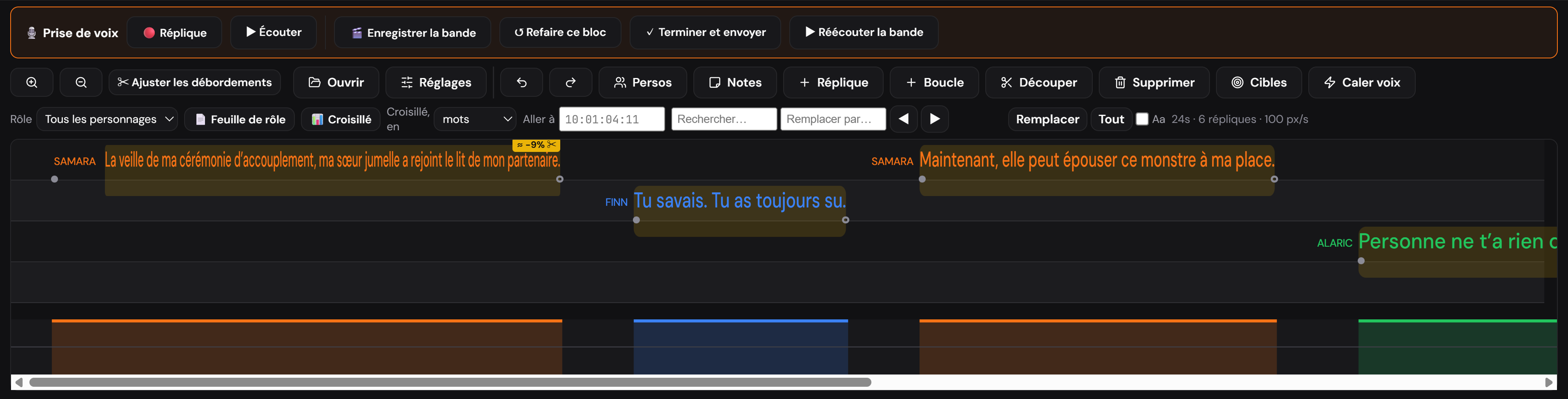
What the application does
Five modules out of 9, and what each one actually does.
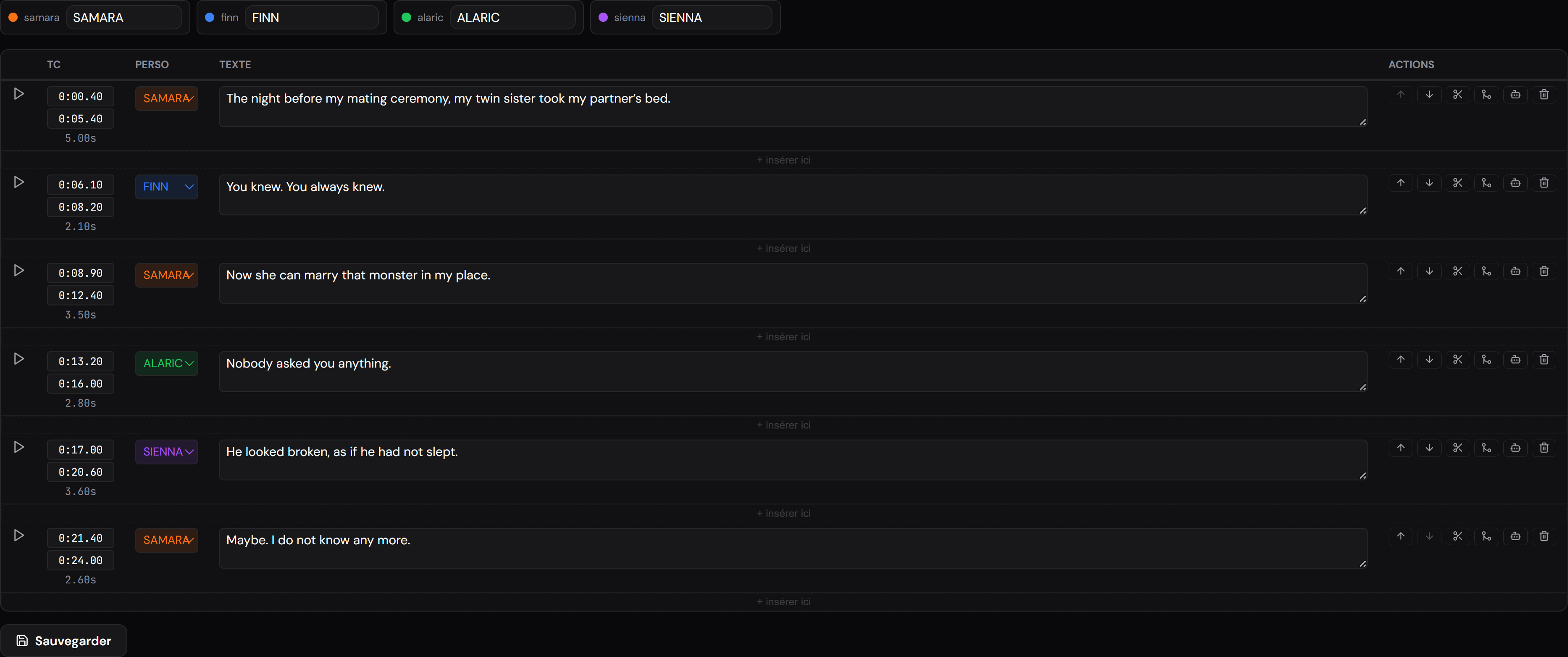
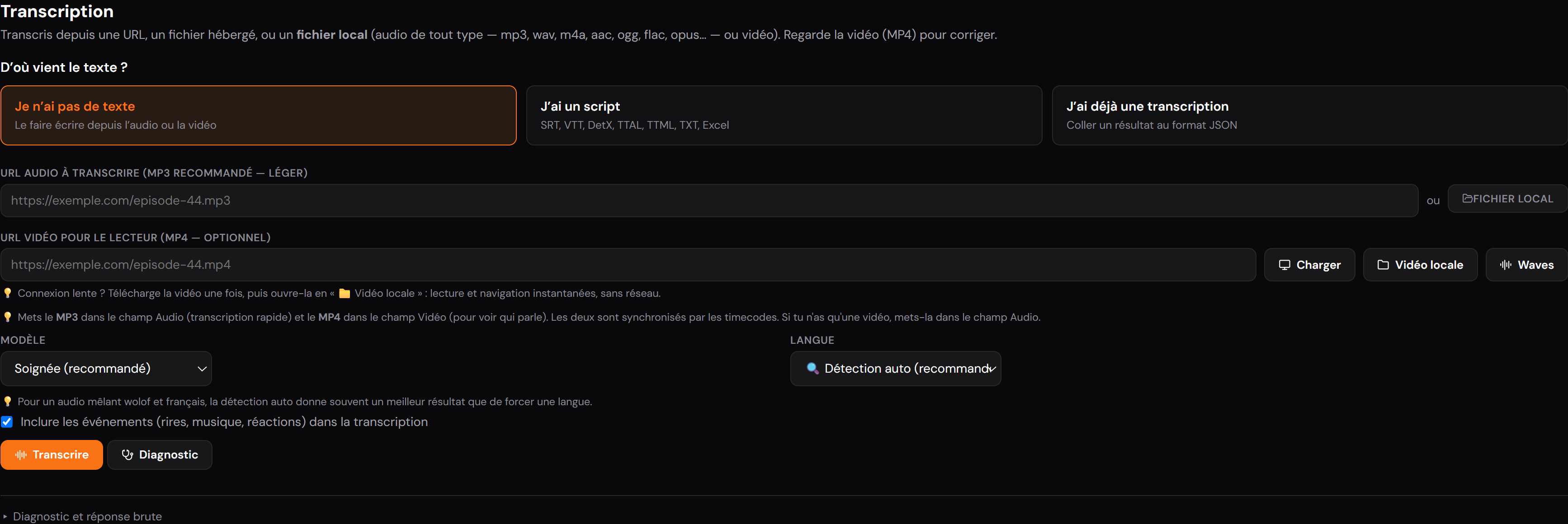
PLACEHOLDERFourth view still to come. Series module: episode grid and open series bible.
Six questions
The ones asked most before trying.
Does the material stay on the workstation?
Mostly, yes. Lip detection, the 77,288-entry lexicon and source separation run offline, with no connection. What leaves, when you start a transcription, is the audio track; and for generated voices, the text of the lines. The video, never.
What happens when the client no longer has the M&E?
The separation module rebuilds both tracks from the stereo mix, on the workstation: the original dialogue on one side, music and effects on the other. That is what lets you deliver a complete dubbed version instead of turning the job down.
What can I import and export?
In: SRT, VTT, DetX, AAE, TTAL, TTML, TXT and Excel. Out: DetX, SRT, VTT and TXT. DetX and SRT come in the original or the adapted version. Add to that EBU STL for European broadcasters and TTML/IMSC for platforms.
The cut changed. Does everything have to be redone?
No. Conforming carries the text onto the new version by timecode alignment, and flags line by line what moved, what vanished and what is new. You review the differences instead of re-timing the whole episode.
What is the QC sheet?
Three checks on the file actually delivered: levels against the broadcast target, whether every line is really present in the mix, and synchronisation: constant offset and progressive drift reported separately, with the likely cause named. Nothing is corrected silently: everything is measured, quantified, and written into a sheet you attach to the delivery.
Is there a macOS build?
Not today. Axeho has never been compiled or tested on macOS. Announcing a file we do not have would be lying to you: Windows only, for now.
See the full help section → 313 indexed answers
Download, or choose a plan
The installer and the licences are ready.
Try it on an episode you already know
Import the video and the source-language subtitle, and watch what the detection offers. Five minutes is enough to tell whether an adaptation tool holds up.
Windows 10/11 · 206 MB · SHA-256 published · 10 August 2026
Licences
Choose your plan
A free plan to try, paid plans for whatever you need — monthly or yearly.
Secure payment, by card or mobile money.
And knowing what the episode cost
Another product, sold separately.
Assignments priced by trade, by the minute of programme, except actors, by the line or by the day. Provider invoicing with an explicit cycle and gap-free numbering. Payouts by transfer or mobile money. Profit and loss per episode.
Project management and invoicing →
Sold separately, partitioned per studio: your currency, your trades, your rates.